
I’ve noticed a few of you have been searching the site for “artificial surf.” Fair enough, it’s a good question, and it turns out to be a bigger one than I expected.
So here’s the thing I haven’t tried any of this. Everything I know about surfing so far has come from the actual sea, wobbling about at Bigbury on a hired board, mostly delighted just to still be in the vicinity of it – I was going to say on it – but that’s expecting a lot. I have no experience of artificial surf and I haven’t tried a Flowrider.
But people are clearly curious about it, so I went and did the digging so you don’t have to. And along the way I found something I think is actually more interesting than the wave pool list itself: how far the idea of “blue space” really stretches. And, it’s not just the sea, or even a lake. It might be the fountain outside your local shopping centre.
How Many Artificial Surf Spots Are There in the UK?
Short answer: there are two proper artificial surfing lakes open in the UK right now I can find, where you ride a real, moving wave on a surfboard. Then there’s a separate, much longer list of FlowRiders, which are a different kind of machine entirely, and a couple more wave pools currently being built or planned.
So “how many” depends what you mean by artificial surf. Which, it turns out, is exactly the same question people ask about blue space. More on that in a minute.
The Wave Pools You Can Surf Right Now
These are the real deal, proper moving waves, the kind you’d actually recognise as surfing if you plonked them down next to Bigbury.
The Wave, Bristol — opened in 2019, this was England’s first. It uses Wavegarden technology, so the waves are generated by underwater paddles rather than a wall of water, which apparently makes for a more natural feeling ride. It’s become the benchmark most other UK sites get compared to. It looks phenomenal on their website, such clever technology.
Lost Shore Surf Resort, near Edinburgh — the newest of the two, opened in a former quarry in Ratho in November 2024. It’s currently Europe’s largest wave pool and can apparently churn out up to 1,000 waves an hour, which sounds both brilliant and slightly terrifying.
So that’s your two England and Scotland covered, but unfortunately not Wales.

And then there’s a proper British curiosity: the Severn Bore, a tidal wave that surges up the River Severn and has genuinely been surfed since 1955, when a WWII colonel rode it on a homemade board. The current world record for a single ride is over 7 miles. It’s a remarkable thing to watch or try, but worth being clear that this is experienced-surfer-only territory, fast moving water, floating debris, and a strong local message not to go it alone, so it’s not really a beginner’s way in, more a bucket-list oddity once you’re already surfing.
Also, just to clear this up as it comes up as an option – Adventure Parc Snowdonia in North Wales opened in 2015 as the world’s first commercial artificial surf lake. It closed in September 2023 due to wave-machinery faults. In September 2025, it reopened under new ownership (The Interesting Hotels Group) as a land-based activities centre featuring high ropes, indoor caving, soft play, and a café. However, the surf lagoon remains offline. While it is currently off the list for surfers, the site’s ongoing turnaround makes it worth watching for future updates.
More on the Way
A few more are somewhere between “planning application” and “diggers on site,” so worth keeping an eye on if you’re not near Bristol or Edinburgh:
- Surf London, planned for the Lee Valley Leisure Complex in Edmonton, north London. This one’s furthest along of the bunch, and led by Crest Experiences, the same team behind The Wave in Bristol. It’s a £60m project centred on a 200-metre-wide lake using Endless Surf’s pneumatic technology, the same system used in Munich. Enfield Council approved the planning application in September 2025, but it isn’t fully signed off yet, the site sits on Green Belt land, so it still needs sign-off from the Greater London Authority and a Section 106 agreement before construction can start, which is currently pencilled in for 2026, with an opening targeted for 2027.
- Emerge Surf, Coleshill, near Birmingham. This one’s had a bumpy road, first announced back in 2019, it was bought out in a £50m deal by Stoneweg InfraSport, who are aiming to finally get it finished, though there’s no confirmed opening date yet.
- Surf X, East Midlands, a £25m project using a different wave technology to the others, Surf Lakes rather than Wavegarden or Endless Surf. Still at an early stage, no construction confirmed.
- Brocks Pine, a proposed surf lagoon near St Leonards in Dorset. It actually got planning permission back in February 2024, but the local council then declined to enter commercial talks over the land, so it’s currently stalled while the developers look for an investor or operator. No wave technology has even been chosen yet.
None of these have opening dates I’d trust enough to print just yet, but London’s project in particular is looking like the one to watch.None of these have opening dates I’d trust enough to print just yet, but London’s project in particular is looking like the one to watch.
FlowRiders: The Easier Way In
This might be a little more helpful… because a wave pool might be a fair trek and expense for most people, and a FlowRider is neither of those things.

A FlowRider isn’t a wave you ride across. It’s a thin sheet of water blasted up a fixed slope at speed, so you stay in one spot, more like a treadmill for surfing than a lake. You can bodyboard lying down or “flowboard” standing up, and because it’s usually bolted onto a leisure centre or activity park rather than a dedicated resort, it tends to be a lot more accessible for a rainy Saturday.
There are a good few dotted around the UK, including:
- Redcar Leisure Centre, Tees Valley
- Retallack Resort, Cornwall (billed as Cornwall’s only one)
- Cardiff International White Water, Cardiff (their FlowRider is tucked inside the white-water rafting centre)
- LC, Swansea, Wales, home to a Boardrider machine billed as the first of its kind in the world
- Merton Aquadome, Jersey (the Channel Islands’ only one)
If you’ve got a leisure centre near you with a “surf simulator” or “FlowRider” session on the timetable, that’s what it is. Worth ringing ahead, since a lot of these run bookable sessions rather than drop-in.
Whatever Happened to Surf Reefs?
Quick bit of history for you. Before wave pools took off, there was a different idea: the artificial surf reef. Bournemouth had one off Boscombe back in 2009, made of giant sandbags on the seabed, designed to shape the natural sea swell into a better surfable wave. It was Europe’s first. It also lasted about two years before a boat damaged it and it was never really fixed. So, a nice idea, not quite a lasting one, and pretty much a dead end as a technology since.
Blue Space Isn’t Just the Sea
Right, here’s the bit I actually found myself getting properly interested in while researching this.
You’ll have seen me bang on about “blue space” before, and up to now I think I’ve mostly meant it the way most of us instinctively do, the sea, a lake, a river, somewhere with a wetsuit involved. But the actual research on this is a lot more generous than that.
Researchers define blue space as any outdoor environment, natural or man-made, that features water and that people can see, hear or get near. And that includes things I’d never have thought to count. Academic reviews of “urban blue space” routinely list coasts, rivers, lakes, canals, ponds and fountains within cities as all counting equally. Not just wild, dramatic water. Ponds. Canals. The fountain outside the train station.
There’s proper evidence behind this too, not just a nice idea. Water has been shown to help mask traffic noise, easing the stress caused by a loud cityscape, and researchers studying stress regulation have found that simple contact with water slows down the body’s stress response and helps induce calm. One study went further and looked specifically at which kind of water sound does the most good, and found that the sound of rivers, fountains and streams gave people the biggest restorative boost of all the urban blue spaces tested.
Which, when you think about it, tracks. Nobody stands beside a fountain and feels worse for it.
There’s also something reassuring in this for anyone who, like most of us, doesn’t live five minutes from a beach. Researchers have found that lakes, rivers, canals, wetlands and even urban fountains offer many of the same mental health benefits as the coast, because they share the same essential ingredients for restoration: visual openness, the movement of water, calming sound, and a reflective surface. You don’t need Bigbury. You need a pond.
Why Any of This Is Good for You
I know I keep coming back to this “Blue Mind” idea, but it’s worth saying plainly here because it applies to a wave pool exactly as much as it applies to a beach: the water doesn’t seem to mind whether it’s the Atlantic or a converted quarry in Ratho.
There’s decent evidence for that too. One large piece of research followed people in Glasgow over ten years, looking at whether living near blue space made any real difference to mental health, especially in more deprived areas. It found that living close to blue space measurably softened the usual link between deprivation and mental health risk. That’s not nothing.
So whether it’s a wave pool, a FlowRider, a proper wild sea day at Bigbury, or just five minutes by the duck pond on your lunch break, the underlying thing seems to be the same. Water, visible or audible, does something for us that’s measurable, not just a nice feeling I’ve been telling myself is true because I like being wet.
I Haven’t Tried It Yet, But…
Everything above is research, not experience. I’ve not been on a FlowRider, never stood in a wave pool, and the closest I’ve come to “artificial” surf is watching clips of people looking considerably more graceful than I ever have in the sea.
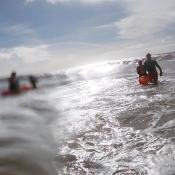
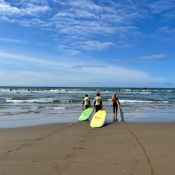
What I have done is learn to surf properly, at 50, in North Devon, badly at first, and with a fair bit of nerve-wobbling beforehand. If you’ve read that one, you’ll know it wasn’t really about becoming brilliant at surfing. It was about being out there in the blue, bobbing about, looking back at the land from somewhere completely different.
Which is actually what makes me curious about a wave pool now. Because from what I can tell, a lot of what I loved about that day, the movement, the trying something new, isn’t really about salt water specifically. It might translate. It might not. I genuinely don’t know yet. I do love the sea. I did love the sitting on the board bit, with my legs dangling, trying to figure out which wave to catch. I still don’t know what makes a great wave, the instructor certainly knew. It was also lovely getting tired, so just chilling and breathing and enjoying the rise and fall of the board. Oh and watching the other riders do their thing. Hmmm maybe it is the sea for me.
Anyway, consider this an open invitation to myself as much as anyone. If anyone fancies coming with me to find out, you know where I am (or you could probably track me down – but don’t be weird).
Quick Questions
How many artificial surfing lakes are there in the UK?
Two are currently open with working wave lagoons: The Wave in Bristol and Lost Shore near Edinburgh. Adventure Parc Snowdonia in North Wales, the original site, reopened in 2025 but as a land-based activity centre, its surf lagoon isn’t running. Several more wave pools are in planning or under construction, including one in London targeted for 2027.
What’s the difference between a wave pool and a FlowRider?
A wave pool generates a real, moving wave that you ride across, much like the sea. A FlowRider blasts a sheet of water up a fixed slope, so you stay in one spot, more like a surf treadmill.
Is a FlowRider easier to find than a wave pool?
Yes. There are only two open UK wave pools, but FlowRiders and similar machines are dotted through leisure centres and activity parks across the country, including sites in Tees Valley, Cornwall, Cardiff, Swansea and Jersey.
Does “blue space” only mean the sea?
No. Researchers define blue space as any water people can see, hear or access, which includes rivers, lakes, canals, ponds and even urban fountains, not just the coast.
Do I need to live near the sea to get the wellbeing benefits of water?
No. Studies have found that inland and urban blue spaces, including fountains and ponds, offer many of the same restorative and stress-reducing effects as coastal water.
A Few Other Ways to Practise
A quick side note, since not everyone’s near a wave pool or a leisure centre with a FlowRider, and because I’m interested in how to balance, use my muscles quickly, be relaxed and get a stronger core:
Balance boards (Indo Board is the best known brand) are a small wobble board with a roller underneath, designed to mimic the constant tiny weight shifts you make standing on a moving wave. They’re cheap, fit in a living room, and are genuinely used by professional surfers for off-season training, not just a novelty.
Surfskating is a skateboard fitted with special trucks that let it carve and pump the way a surfboard does across a wave face. It’s brilliant for building the turning and weight-transfer muscle memory, and Lost Shore even runs a SurfSkate Academy on site for exactly this reason.
If you’ve tried any of the UK’s wave pools or a FlowRider, I’d love to hear what it’s actually like, drop me a message. And if this is the year you finally try surfing for real, have a read of how my first go at 50 went first – not that I’m showing off but I did stand up (beginners luck maybe.