Why more women are turning to open water swimming for joy, resilience and a reset from modern life
There’s something happening at rivers, lakes, beaches and tidal pools all over the UK. Before work and the school run. Before the laptop is opened or caring responsibilities kick in. Or even sneaked at lunchtime, or after the evening meal is cooked and served.
Women are quietly walking into cold water. And as a note you could and probably should read ‘quietly’ as raucously, and walking as ‘jumping’. It’s not, in many cases, a subdued activity.
Some arrive in bobble hats carrying flasks of tea. Some are nervous first-timers standing at the edge in oversized changing robes (yes they’re still very much a staple). Others move with the confidence of people who know exactly what the water is about to give them.
And increasingly, research is exploring what swimmers themselves have been saying for years
A recent study published in the European Journal of Ecopsychology explored the impact of open water swimming on middle-aged women and found powerful links between swimming outdoors and emotional wellbeing, resilience, connection, optimism and even flourishing, described within psychology as one of the highest forms of wellbeing.
Mind, most swimmers could probably have told you that already. If you spend enough time around people who swim in rivers, lakes and the sea, you start hearing the same phrases again and again.
“It resets me.”
“I feel like myself again.”
“I can cope better afterwards.”
And perhaps most perfectly of all:
“I’ve never come out of the water wishing I hadn’t got in”
Open water swimming (or wild swimming) is much more than exercise
What feels interesting about the rise of open water swimming is that it doesn’t really feel like a fitness trend. Yes you can look for personal bests and distance, speed and skill level, but there’s more to it.
Of course there are physical benefits too. Swimming outdoors gets people moving and encourages people to spend more time outside. Speak to outdoor swimmers, and thankfully, the conversation rarely begins with calories or exercise goals.
Instead they talk about relief.
They talk about breathing again.
They talk about the feeling of leaving stress on dry land, stress they sometimes didn’t even know they were carrying.
The study found women repeatedly described the water as a “reset”. A place where racing thoughts quietened down and attention moved fully into the present moment.
That makes sense when you think about it, as cold water demands your attention, especially if you’re in nature. You notice your breathing and where you are stepping. You notice your body (and where neoprene starts and finishes) and your skin. You notice the ducks crossing the lake, the ships on the horizon, the changing colour of the sea, the sound of pebbles moving in the tide, the lobster pots… the list is inexhaustible.
You aren’t scrolling, you aren’t planning dinner, or thinking about the things you didn’t get done.
You are breathing, minding your feet, feeling, watching and simply being.
Present.
And in a world which increasingly pulls our attention in every direction, that’s part of the attraction, even though I believe that’s not what people go looking for.

The quiet power of “alone but connected” and blue wellbeing
One of the most striking parts of the research explored the idea of women feeling “alone but connected”.
It described something many outdoor communities seem to understand instinctively.
You can arrive by yourself. You don’t have to perform. You don’t need to be the loudest person there. You can dip in, chat a little, swim quietly and leave.
But you still feel part of something and there’s something remarkably comforting about that.
Perhaps especially at a time when many women are balancing careers, caring responsibilities and the emotional load of daily life. And for many women, it can also be a time of life where they feel increasingly overlooked or invisible.
Open water swimming seems to offer community without too much demand.
Women in the study talked about forming friendships through swimming groups, WhatsApp chats and shared rituals. Some spoke about strengthened relationships with partners and family members.
Others simply described the comfort of being around people who understood.
There’s no perfectly curated social media lives being shared in the water (ah well maybe a few selfies), and there’s no networking (perhaps a sharing of the best latest kit), but demands are little. We talk, or we don’t talk, we check conditions and decide how cold it will be today.
The menopause and cold water swimming conversation
Interestingly, one of the strongest themes to emerge from the research wasn’t even something participants had been directly asked about, but again and again, women brought up menopause.
Some described feeling calmer and more emotionally stable after swimming. Others spoke about stress reduction, better coping mechanisms and feeling more in control of their emotions. One woman described swimming as helping her feel like “a normal human being” again.
More than one woman I swim with has joked that their partner can tell when it’s probably time for a swim again. Brave words.
Because despite growing conversation around menopause in recent years, many women still feel unsupported, unheard or expected to simply carry on. While open water swimming is certainly not a cure-all, there’s something important about spaces where women feel stronger, calmer and more connected to themselves.
Particularly spaces outdoors away from expectations and appearance.
One swimmer in the study reflected that swimming outdoors made her appreciate her body for what it could do rather than how it looked.
I do feel more connected to my body as an outdoor swimmer. It is tremendous how the body adapts to water and cold. It makes me feel powerful.
Why it’s different swimming in open water
It’s vastly different swimming in chlorinated lanes and fluorescent lighting. Following the lines at the bottom of the pool to the edge, where you turn around and head back around. Oh and is it clockwise, or anti-clockwise this time. Woe betide you getting it wrong.
Real water and all the real creatures that come in it. Weed, rocks, salt, mud, jellies, fish, currents, tides… it’s all in there.
The women in the study repeatedly compared open water swimming positively against gyms and pools.
Some described feeling claustrophobic indoors.
Others spoke about wildlife, changing seasons and being immersed in nature.
And perhaps this is where open water swimming becomes about something bigger. The reconnection to changing seasons and the reminder that we are changing too, and that’s ok.
At a time when so much of modern life happens through screens, artificial light and constant noise, there’s something profoundly human about watching sunshine glint on the water, it really is that simple.
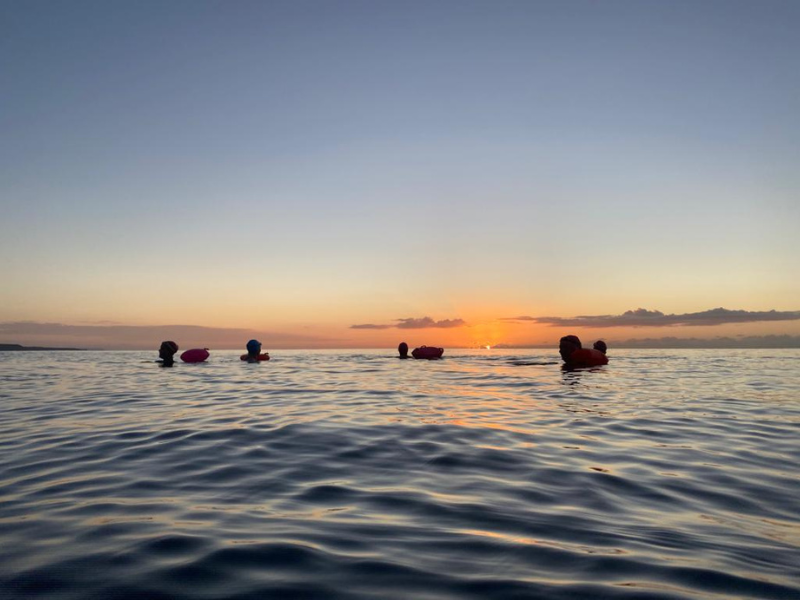
Finding the joy in open water
What I loved most about this research was that alongside all the academic language around wellbeing, resilience and flourishing, there was another thread running through it too.
Joy.
Not productivity. Not self-improvement.
Joy.
If you know me, you’ll know this is one of my very favourite words.
One woman in the study simply described open water swimming as “a bloody joyous thing to do.” I think she should be recruited as a new friend. So maybe that’s part of the reason this movement continues to grow.
Not because people are trying to become something else, but just to feel joy. That’s pretty straightforward. Who would say no to a pocketful of joy?
So it might help you be more resilient, provide you with a little calm too, but it’s also a bit silly, unhinged and brave and all those other things too. Oh and awe. Us little humans racing around doing all the important things… then you realise just how tiny we are, just playing a tiny part, and we should really just enjoy it.
Even on cold grey mornings. Especially on cold grey mornings.
Maybe that’s why people keep returning to the water, not to escape life, but to come back to it a little more fully.